
You’re exhausted, the room is dark, and yet your mind paces like it’s on a deadline. That “tired but wired” feeling isn’t just bad luck — it’s biology. More specifically, it’s your body clock showing up late to the night shift.
New research is sharpening the picture. A study published in Sleep Medicine by University of South Australia scientists mapped mental alertness across the day and found that many people with chronic insomnia carry their cognitive “peak” into the evening. In plain English: their brains don’t power down on schedule. This is the “cognitive hyperarousal” insomniacs describe — not just racing thoughts, but a delayed daily rhythm in how alert the brain wants to be.
The delay that keeps you awake
Picture this: your body’s ready for bed at 1 a.m., but your calendar says 11 p.m. Because your internal clock — anchored by the brain’s suprachiasmatic nucleus — is running a little late, melatonin (your “dim-light” sleep signal) rises later, core body temperature dips later, and your mental engine idles high right when you want quiet. You feel sleepy at 6 a.m. and wired at 11 p.m. That mismatch is insomnia’s sweet spot.
That UniSA Sleep Medicine study tracked cognitive rhythms in people with long-term insomnia and healthy sleepers. The insomniacs’ alertness curve stayed elevated into the night — a strong hint that for many, insomnia isn’t only about stress or poor habits; it’s a timing problem. And timing problems respond to… well, timing-based solutions.
Treat the clock — not just the thoughts — if your brain won’t switch off at night.
This isn’t confined to any one group, either. A 2025 systematic review in Sleep Advances highlighted just how widespread insomnia symptoms are among university students — an age group known for late schedules, heavy screens, and social jet lag. When life pushes your clock later, sleep pays the price.
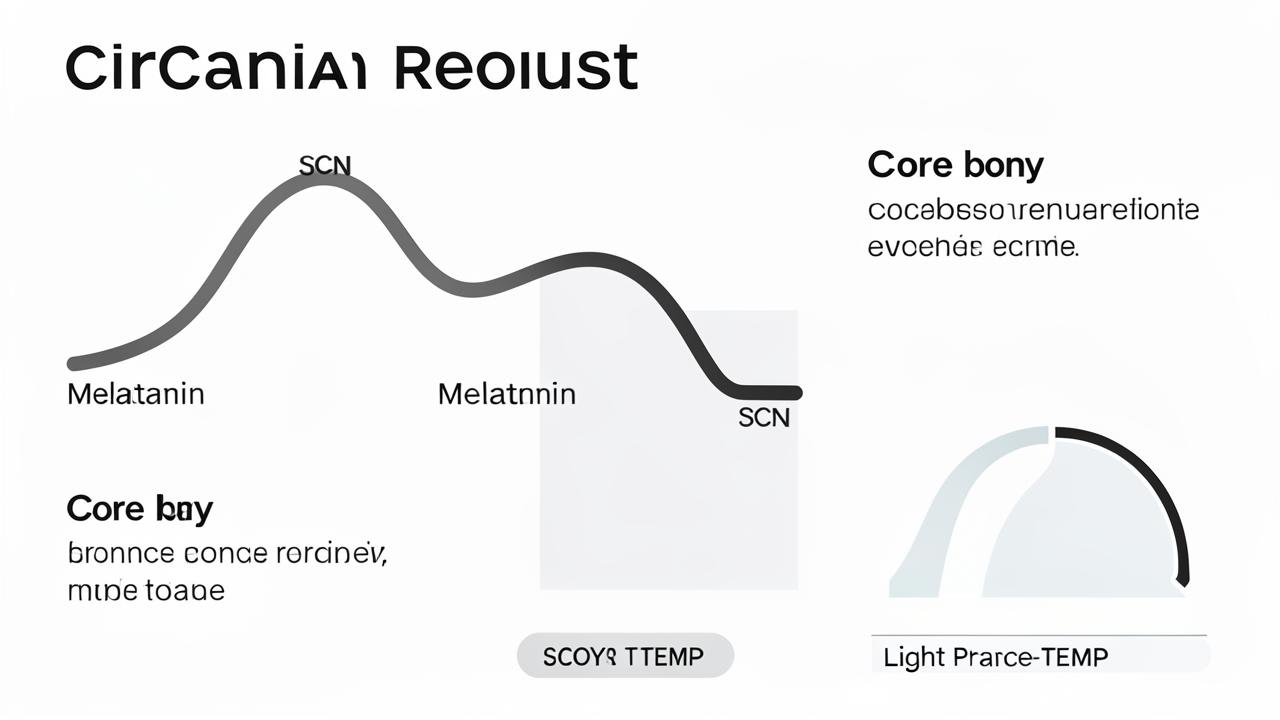
Your 24-hour system, briefly explained
Here’s the thing: you have two forces steering sleep. One is sleep pressure (the longer you’re awake, the more you need sleep). The other is your circadian rhythm — a 24-hour timing system that sets when you can sleep easily. Bright light in the morning nudges that clock earlier; bright light at night pushes it later. Meals, movement, and temperature are supporting actors.
You know that feeling when Monday’s 7 a.m. alarm hits like jet lag after a late-weekend binge of streaming and takeout? That’s a mini circadian delay. Stack enough of those, and your “natural” sleep time migrates past the hour your life requires. Insomnia thrives in that gap — you’re trying to sleep against your biology.
Shift the clock, calm the mind
Most people have been there — you try everything “sleepy” at 10:30 p.m., yet your brain insists it’s still prime time. The fix isn’t just lavender and hot tea. It’s precision. Use light, behavior, and a steadier routine to inch your clock earlier, while you unwind the mental churn.
Morning: set the anchor
- Get outside for 10–20 minutes of natural light within an hour of waking. No sunglasses if safe for your eyes; skip the hat brim. Cloudy counts — daylight is strong.
- Hold a consistent wake time — yes, weekends too. The wake-up is your clock’s daily reset button.
- Move your body. Even a brisk 10-minute walk amplifies your morning alerting signal.
Afternoon: protect the slope
- Cap caffeine by early afternoon. It’s not just falling asleep — late caffeine can blunt deep sleep later.
- Keep naps short (10–20 minutes) and before 3 p.m., or skip them while you reset.
- Time meals earlier. Emerging circadian nutrition research suggests late, heavy dinners can keep peripheral clocks running behind.
Evening: dim and wind down
- Dim lights 2–3 hours before bed; minimize blue-enriched light. Use warm lamps and night modes on screens. Better yet, park the phone.
- Create a 30–45 minute wind-down: shower, read paper pages, light stretches, breathwork. Protect it like a meeting.
- Consider low-dose, earlier-evening melatonin for delayed sleep schedules — especially if your “natural” sleep time drifts later. Timing matters; talk with a clinician about whether and when it fits you.
And about the mind that won’t shut up: cognitive behavioral therapy for insomnia (CBT‑I) teaches you to unpair the bed from worry and rebuild sleep pressure smartly. Digital CBT‑I programs have shown benefits in large trials and are being followed in real-world settings — for example, a 2025–2030 practice-based study is tracking outcomes in insomnia and circadian rhythm patients across a sleep clinic network. If your insomnia’s been around for months, CBT‑I is worth it.

When stress and identity weigh in
Because sleep lives in the world, not a vacuum. At the SLEEP 2025 scientific meeting, researchers from the University of Miami reported that higher everyday discrimination scores were tied to more severe insomnia in women in their sample, but this link didn’t reach significance in men. The takeaway isn’t to generalize wildly — it’s to acknowledge that social stressors may land differently across groups, and support should be tailored.
Relationships matter, too. One research program (the CHARMS study) is examining how sleep and daily rhythms play out in older adult couples. You know the drill: one partner is a night owl, the other a lark. Bedtime becomes a negotiation, and mismatched light and noise cues tug on both clocks. Sometimes the healthiest move is two wind-down windows or staggered bedtimes while you realign together.
Actionable Takeaway
If your brain won’t switch off at night, assume a delayed clock and run a one-week phase‑advance reset.
- Pick a realistic wake time and lock it for 7 days — no exceptions.
- Morning light: 15 minutes outdoors within 60 minutes of waking; add another 10 minutes around late morning if you can.
- Evening light: dim the house after sunset; screens off 60 minutes before bed; use warm bulbs.
- Anchor meals: breakfast within 2 hours of waking; finish dinner at least 3 hours before bed.
- Worry buffer: schedule a 10-minute “download” after dinner — write the to‑dos, choose tomorrow’s first step, close the notebook.
- Wind-down: same relaxing routine every night, same order, same cues.
- Bed only when sleepy; if you’re awake and wired after ~20 minutes, get up, keep lights low, do something quiet, return when drowsy.
- If insomnia persists or your schedule is extremely delayed, ask a sleep clinician about timed bright‑light therapy and whether precisely timed low‑dose melatonin could help.
What’s surprising is how quickly the system responds. Two or three mornings of real daylight plus stricter evenings can start nudging your rhythm. The real kicker? The boring stuff — consistency — is the potent stuff.
So, what does this mean for your Tuesday morning? Treat sleep like a timing problem you can train. Align the light, keep the wake time steady, give your mind a lane to slow down. When your clock shows up on time, your brain finally gets the memo: night is for off.